I was reviewing a helper in my codebase. It counts decimal places of an amount. Here it is.
def _decimal_places(value: float) -> int:
    try:
        decimal_value = Decimal(str(value)).normalize()
    except (InvalidOperation, ValueError):
        return 0

    exponent = decimal_value.as_tuple().exponent
    return max(0, min(6, -exponent))
To understand how it works, I studied the helper in a Python REPL. 5.23 came back as 2.
5 and 5.0 both came back as 0.
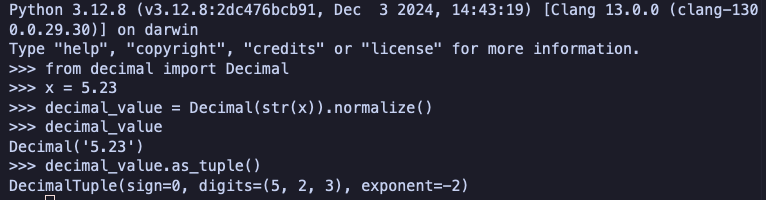
str(value) hands the float to Decimal.
Then .normalize() strips trailing zeros, and .as_tuple() breaks what is
left into sign, digits, and exponent. The helper negates the exponent and
clamps the result between 0 and 6. The normalize is why 5 and 5.0 agree.
Then I passed float('inf').
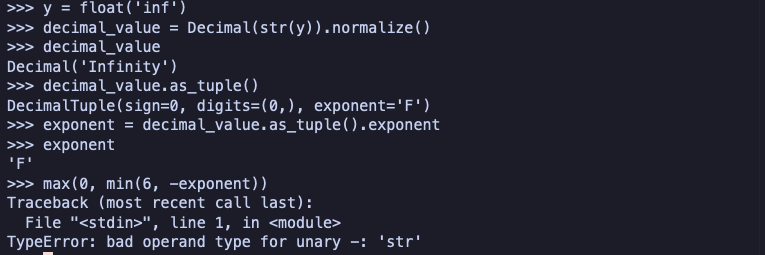
Decimal('Infinity') parses fine. The exponent came
back as 'F'. A string. One line later the helper ran -exponent on it, and
Python raised TypeError: bad operand type for unary -: 'str'.
So I went back and looked at the guard. The try/except wraps the construction
only. A garbage string dies in there with InvalidOperation, and the helper
returns 0. The guard caught the parse and missed the crash.
NaN is stranger. Its exponent is 'n', and its digits tuple is empty. It
reaches the return line too.
My fix checks the type at the crash site.
    exponent = decimal_value.as_tuple().exponent
    if not isinstance(exponent, int):
        # NaN / Infinity have no decimal places
        return 0
    return max(0, min(6, -exponent))
The helper returns 0, the same answer bad input already gets.